← All performances
Guzheng
The 21-string Chinese zither, played live — our most-booked act for receptions and dining.
The 21-string Chinese zither, played live — our most-booked act for receptions and dining.
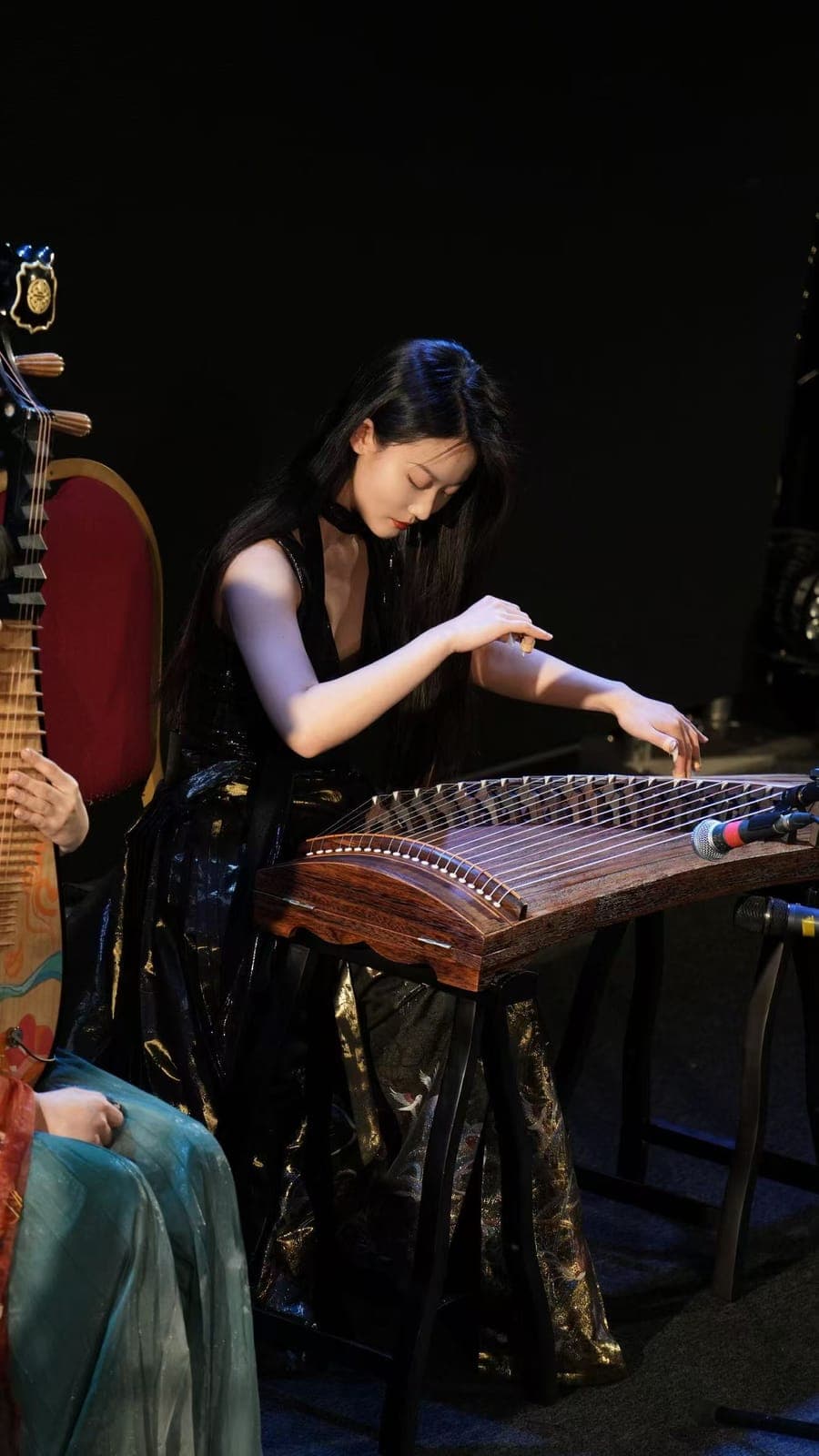
ShowreelA plucked zither with over two and a half thousand years of history, and one of the most recognisable sounds in Chinese music. The right hand plucks with picks bound to the fingers; the left bends the strings behind the bridges, giving the instrument its sliding, vocal quality.
The modern instrument carries 21 strings over movable bridges and stands around 1.6 metres long. The right hand plucks with picks bound to the fingers; the left presses and bends the strings behind the bridges.
The instrument is set up on its stand and played seated, typically in traditional dress. Sets are usually 30–45 minutes with breaks, and can run across an evening.
Repertoire ranges from classical pieces several centuries old to contemporary arrangements, and where it suits the occasion, familiar Western melodies arranged for the instrument.
Volume is naturally moderate. In a dining room it sits underneath conversation; in a quiet gallery or ceremony it can hold the room entirely.
This is the most versatile act on our roster. It suits drinks receptions, dining, tea ceremonies, gallery and museum openings, private dinners and wedding ceremonies.
It is the right choice whenever you want cultural presence without interruption — where a stage performance would be intrusive but silence would be flat.
It has been a scholar's instrument, a court instrument and a folk instrument in turn, and is among the oldest in continuous use in China.
The instrument is acoustic and needs no amplification in most rooms. In very large or noisy spaces we can provide light reinforcement.
It needs a stable, level surface and a chair. It is sensitive to temperature and humidity — outdoor performance is possible in settled weather but needs shade and cover.
Yes. Many pieces arrange well for guzheng, and it works nicely at weddings and mixed-audience events. Send your requests and we will tell you honestly what suits the instrument.
Typically sets of 30–45 minutes with breaks, across an evening.
Not in most rooms. For large or noisy spaces we can provide light reinforcement.
In settled weather, with shade and cover. The instrument is sensitive to damp and heat.
Yes — it combines well with erhu and pipa. See our Music Ensemble.
Pipa · Erhu · Music Ensemble · Weddings · Private & Special Occasions