← All performances
Sichuan Opera Mask Changing
One of the most closely guarded techniques in Chinese performance, and among the rarest on UK stages.
One of the most closely guarded techniques in Chinese performance, and among the rarest on UK stages.
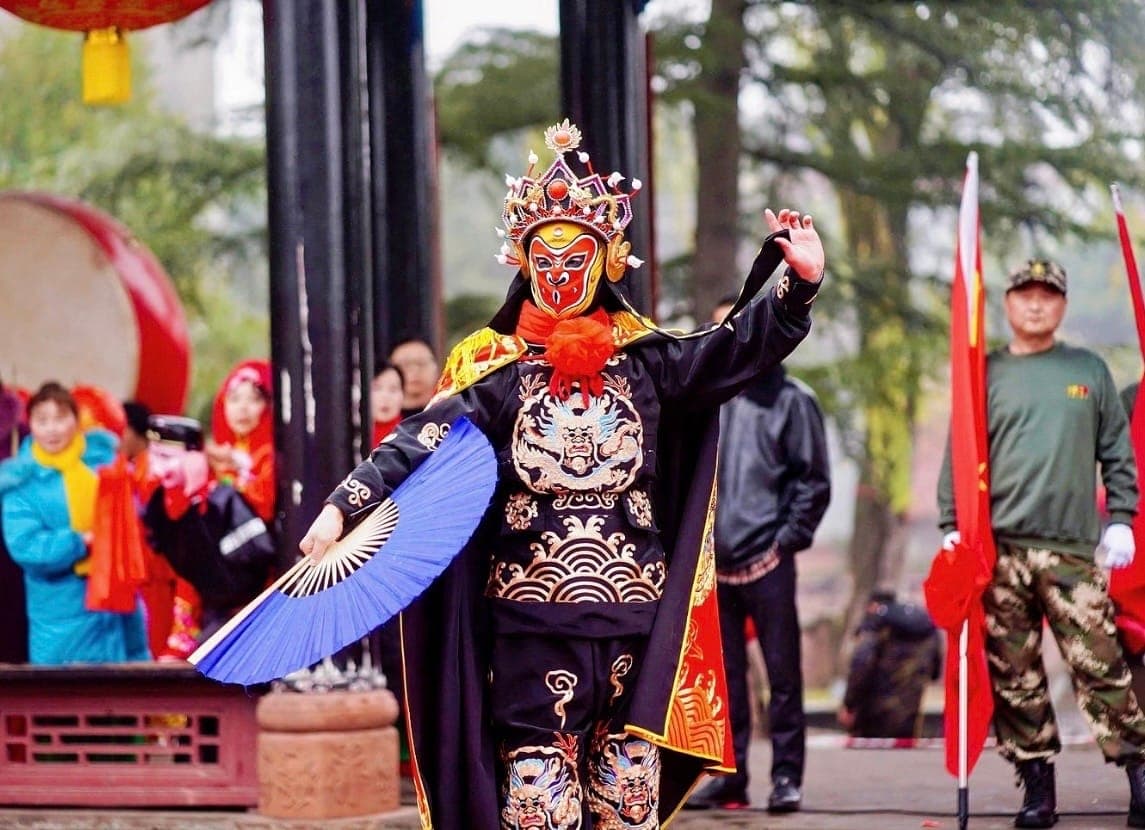
ShowreelA performer's mask changes in the time it takes to blink, repeatedly, in full view, with no visible mechanism. Bian lian belongs to Sichuan opera, where each mask signals a different emotion, and the technique is still taught only within families.
Each mask represents a different emotion or identity, and the performer switches between them in fractions of a second while moving continuously. Very few performers outside China are trained in it.
The performer enters in an embroidered robe, moving in the stylised manner of Sichuan opera. Then the first change happens — a sweep of a fan, a turn of the head — and the face is different.
The changes accelerate: six, eight, sometimes more in a set. Because the performer never stops moving, the effect is genuinely disorienting rather than merely clever.
The final change is usually to the performer's own face.
Mask changing is at its best close up, where guests can see there is nothing to see. It works well after dinner, as a punctuation point in an evening programme, or at a private occasion where the audience is near.
It is short, self-contained and needs no build-up, which makes it easy to place in a tight run of show.
Sichuan opera is one of China's oldest regional forms, and bian lian is its most famous element. The secrecy around the technique is not showmanship — it was designated a protected national art in China.
Needs reasonable lighting on the performer; the changes must be visible. Very dim or heavily coloured stage lighting works against it.
Indoor is strongly preferred, as wind interferes with the costume. A private changing space is required.
That is the one thing we cannot tell you. The technique is a protected tradition, taught only within a small lineage.
Very close — it is more impressive close up. Two to three metres is ideal.
Typically 8–10 minutes. It can be shortened for a tight programme.
We advise against it. Wind affects the costume and masks. Covered outdoor spaces may work — ask us.
Lion Dance · Long Sleeve Dance · Corporate · Private & Special Occasions