← All performances
Ribbon Dance
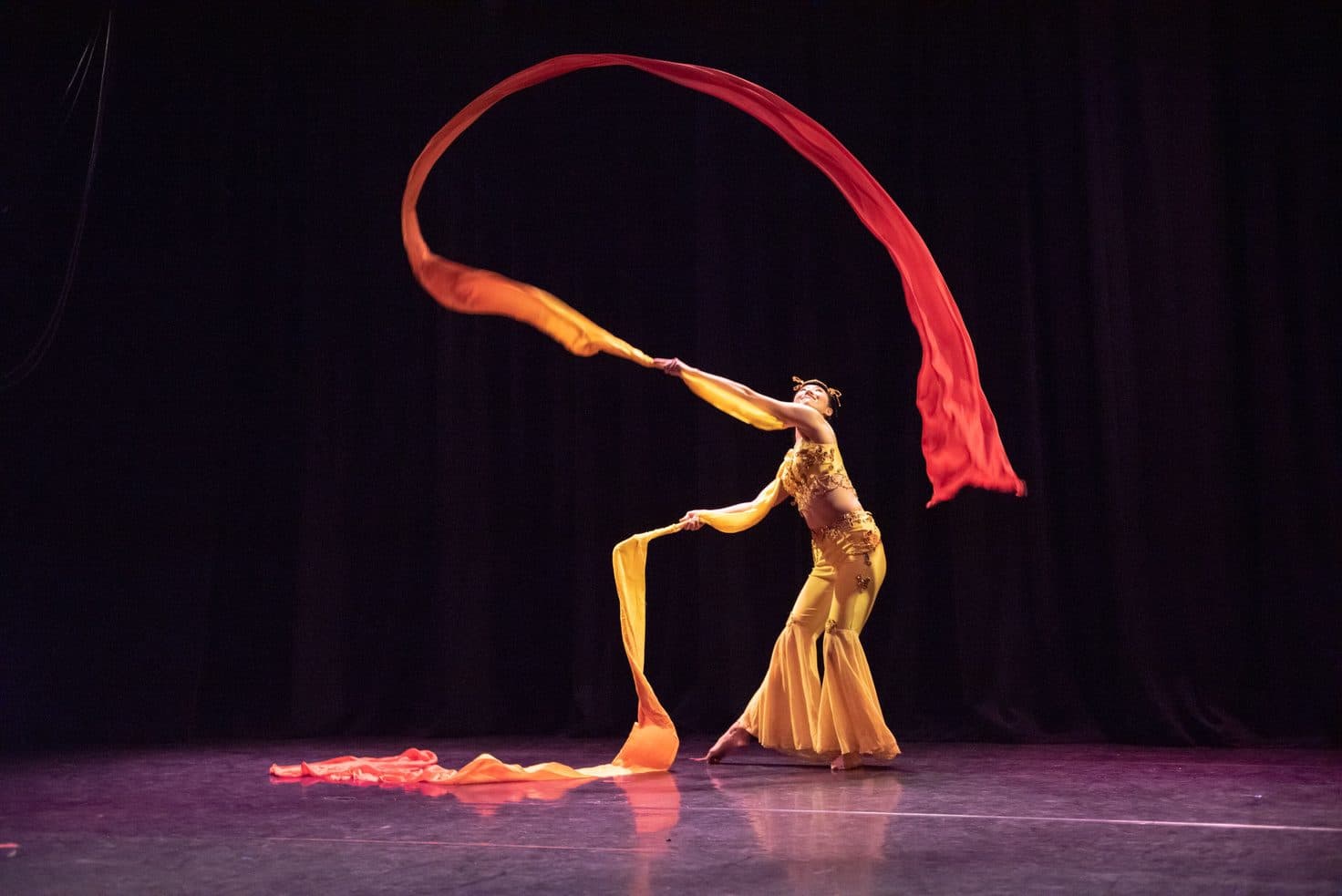
Silk ribbons up to twenty-four metres long, drawn through the air in continuous arcs.
Silk ribbons up to twenty-four metres long, drawn through the air in continuous arcs.
ShowreelLengths of silk attached to short sticks, kept in continuous motion so the fabric never falls slack. Ribbons run from ten to twenty-four metres depending on the piece and the space. The technique is in the wrist, with the whole body behind it.
The technique is in the wrist and the whole body behind it: circles, spirals, figure-eights and long overhead sweeps, each shape sustained by momentum rather than force.
A piece opens with the ribbons close to the body, the shapes small and controlled, before the dancer releases them into wider arcs that travel the full width of the space.
Longer ribbons change the character entirely. At twenty-four metres the silk takes a moment to answer the hand, so the choreography works in anticipation — a shape set moving several beats before it resolves overhead.
Where several dancers perform together the ribbons interleave without touching.
This is a stage and banquet act. It suits a room with height and a clear floor — ballrooms, atriums, theatres and marquees — and reads well from the back.
It is a poor fit for low ceilings or anywhere with pendant lighting in the sweep of the ribbon. In a smaller room a fan dance gives comparable elegance in a fraction of the space.
The imagery is consistently of water and air — flowing rivers, drifting cloud, the movement of the natural world. Which ribbon length is used is a decision about the room as much as the piece.
Space is the binding constraint, and height matters as much as floor area. Ribbons travel overhead, so chandeliers, pendant lights and low rigging all restrict what can be performed. Send a photograph and we will tell you which ribbon length fits.
Indoor is strongly preferred; silk is extremely wind-sensitive. Recorded accompaniment is standard, so playback is the only technical requirement.
A minimum of 8×8 m of clear floor, and around 4m of height for overhead sweeps. Longer ribbons need more. Send a floor plan and we will confirm which length suits the room.
We advise against it. Silk is very wind-sensitive and even a light breeze makes the ribbon unpredictable. A covered outdoor space may work — ask us.
A solo works well in most rooms. Four to six dancers suit a large stage or a wide banquet floor, where the interleaving patterns are the draw.
No. A clear floor is enough, and performing at guest level often works better — the ribbons pass closer to the audience.
Chinese Fan Dance · Long Sleeve Dance · Flame Silk Dance · Weddings · Corporate