← All performances
Japanese Fan Dance
Where Chinese fan dance flows, this one cuts — folding sensu fans held in exact geometry.
Where Chinese fan dance flows, this one cuts — folding sensu fans held in exact geometry.
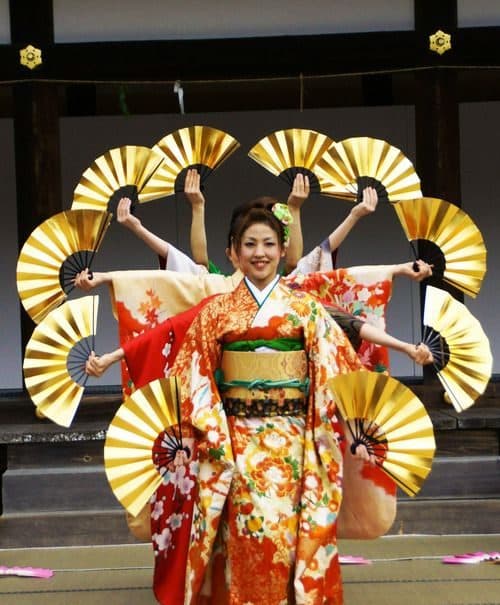
ShowreelThe sensu is the Japanese folding fan, and in dance it is held rather than fluttered. Positions are precise and held long enough to read as shapes. Costume is traditional, but the score need not be — the same choreography sits under shamisen or electronic music.
Positions are precise and held long enough to read as shapes, so a piece is built from a sequence of images rather than continuous motion. The same choreography sits under shamisen or a modern electronic score.
Dancers move between held positions, the fans opening and closing with an audible snap that punctuates the phrase. Where several perform together, the fans are timed to a single instant.
Much of the effect comes from symmetry: fans mirror across a line of dancers, invert, and resolve into a single shape before breaking apart again.
With a contemporary score the tempo rises and the held positions shorten.
This suits a stage or clear floor in front of a seated audience, where the geometry reads properly. It photographs exceptionally well, which makes it a common choice for press moments and launches.
It works less well in the round, where the symmetry is lost from most angles. In that setting a Chinese fan dance is the better booking.
Nihon buyō draws on the movement vocabulary of noh and kabuki, where restraint is the point: the smaller the gesture, the harder the image lands.
A clear floor of around 5m × 5m for a small group, less for a solo. Held overhead positions want about 3m of height. Playback is the only technical requirement.
Suitable outdoors in settled weather. Open fans catch wind more than they appear to, so an exposed site needs checking.
Yes — it is one of the reasons this act is booked. The choreography works under shamisen or a contemporary electronic score. Send the track and we will confirm.
Japanese fan dance is sharper and more geometric, built from held positions and precise symmetry. Chinese fan dance is more continuous and flowing. Both use folding fans; they do not look alike.
A solo works for a small space. Four to eight is where the mirrored formations become the point.
Not necessarily, but the act reads best from the front. If your audience will surround the performers, tell us and we will suggest an alternative.
Japanese Umbrella Dance · Taiko Drumming · Chinese Fan Dance · Corporate · Private & Special Occasions